
目录
As fiber-to-the-home (FTTH) networks continue to expand, choosing the right type of drop cable becomes increasingly important for ensuring stable and efficient connectivity. Among the commonly used options, the figure 8 ftth drop cable and the flat FTTH drop cable are widely deployed in different network environments. While both are designed to connect the main distribution network to individual homes or buildings, their structure, installation methods, and performance characteristics can vary. Understanding these differences can help network installers and project planners choose the most suitable solution.
Structure And Design Differences
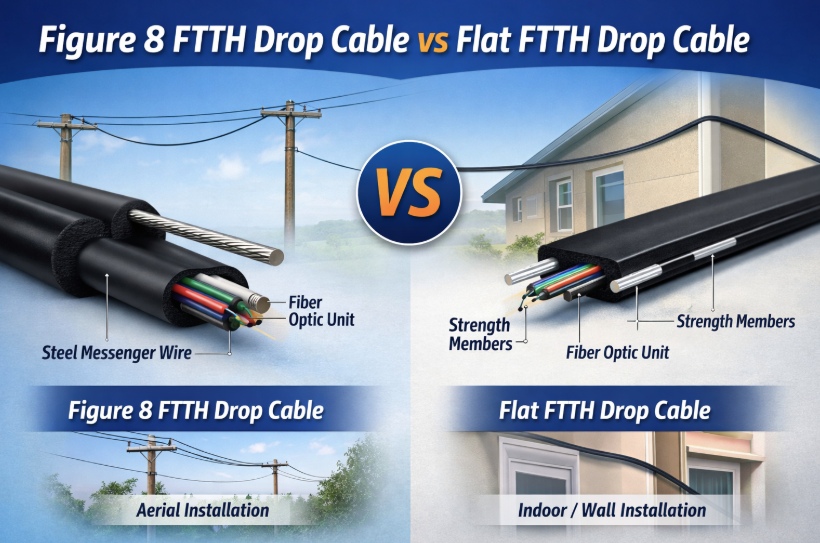
The most noticeable difference between the two cable types lies in their structural design. The figure 8 ftth drop cable features a unique figure-8 shaped cross-section. One part contains the optical fiber unit, while the other part integrates a steel messenger wire that acts as a supporting strength member. This design allows the cable to support its own weight during aerial installation.
In contrast, a flat FTTH drop cable has a flat rectangular structure with embedded strength members on both sides of the fiber. While this design provides good flexibility and compact size, it does not include a separate messenger wire. As a result, flat drop cables are typically installed using additional support hardware when used in aerial environments.
Installation And Deployment
Installation methods are another key factor when comparing these two cable types. The figure 8 ftth drop cable is specifically designed for aerial deployment. The integrated steel messenger wire allows the cable to be directly suspended between poles or buildings. This reduces the need for additional support wires and simplifies the installation process.
Flat FTTH drop cables, on the other hand, are more commonly used for wall-mounted or conduit installations. They are lightweight and flexible, which makes them suitable for indoor routing, facade installation, or short-distance outdoor connections. However, when used in aerial setups, extra hardware such as separate messenger wires may be required.
Strength And Environmental Performance
Because of its built-in steel messenger wire, the figure 8 ftth drop cable generally offers stronger tensile strength and better resistance to external forces. This makes it highly suitable for long-span aerial installations, especially in rural areas or locations where cables must cross streets or open spaces.
Flat FTTH drop cables are designed with durability in mind, but their primary advantage lies in their compact and lightweight structure. They are easier to bend and route through tight spaces, making them ideal for indoor wiring or short outdoor runs. However, they may not provide the same level of mechanical support for longer aerial distances.
Application Scenarios
Both cable types serve important roles in FTTH network construction. The figure 8 ftth drop cable is widely used in aerial fiber networks where cables need to be suspended between utility poles. Its integrated support structure simplifies deployment and enhances long-term stability.
Flat FTTH drop cables are more suitable for building entry points, wall installations, and indoor fiber routing. Their flexible design makes them easy to install in residential or commercial environments where space is limited.
Conclusion
When comparing these two options, the choice largely depends on the installation environment and project requirements. The 8 ftth drop cable is generally the better option for aerial installations and long-span outdoor deployments due to its integrated messenger wire and high tensile strength. Meanwhile, flat FTTH drop cables remain an excellent choice for indoor or wall-mounted installations where flexibility and compact design are priorities. By selecting the right cable type, network builders can ensure reliable FTTH connectivity and efficient infrastructure deployment.
0