

目录
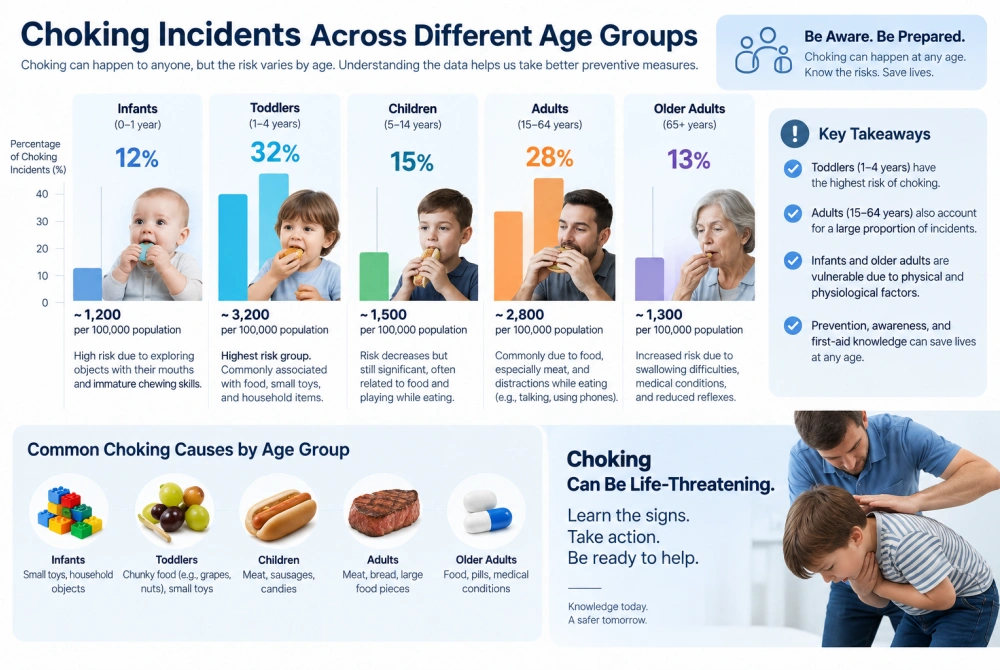
Choking happens when there is an obstruction, either partial or complete, in the airway. In a case where there is partial obstruction, one can still be able to cough out the obstruction. However, in a case of total obstruction, the air is unable to get to the lungs, which makes it very dangerous.
Back blows and abdominal thrusts are not necessarily the first things that one needs to do. One needs to consider a more crucial question first: Is the person able to cough, talk, and breathe?
Basic approach to choking is: Airway sweep → Severe Obstruction → Emergency Call → First Aid Measures
The appropriate approach will also depend on several factors, like age and responsiveness of the person.
1. How Do You Know Whether Somebody Is Choking?
A Strong Cough Usually Means Some Air Is Still Moving
Not every choking incident necessitates immediate physical actions.
When the individual is able to talk, breathe, and cough strongly, air is able to pass through the airway. Coughing is among the body’s natural ways of removing the blockage.
At this point: Coughing Encouraged → Watch → Be Prepared to Act
Never rush to put your fingers into the mouth of the individual. You should also be careful about pushing the abdomen unnecessarily when the individual can cough effectively.
The situation gets serious when the cough weakens, or the individual is no longer able to move enough air.
What Are the Signs of Severe Choking?
Warning signs may include:
• Inability to speak
• Weak or ineffective coughing
• Severe difficulty breathing or no effective breathing
• A weak or silent cough
• Clutching the throat
• Pale, gray, or bluish lips or skin
• Decreasing responsiveness
However, it may be even more alarming if the person is silent. Sound production involves air movement. When someone cannot cough or talk anymore, it could mean that their air passages have been obstructed to an extreme degree.
| Sign | Partial Airway Obstruction | Severe Airway Obstruction |
| Speaking | Usually possible | Often impossible |
| Coughing | Strong | Weak or absent |
| Breathing | Air still moving | Little or no airflow |
| Sound | Coughing/wheezing possible | May become silent |
| Response | Encourage coughing | Immediate first aid |
Recognizing the severity of the obstruction is therefore one of the most important parts of choking first aid.
2. What Should You Do When An Adult or A Child is Choking?
Encourage Effective Coughing First
If the victim is able to cough forcibly and breathe, continue coughing and watch carefully.
If the victim loses the ability to talk, cough properly, or breathe normally, then consider it severe choking.
Call the nearest emergency medical service as soon as possible. Dial 911 in the United States; however, emergency numbers are different in other countries.
Take Action for Severe Choking
If a conscious adult or child suffers a significant airway obstruction, one may use a first-aid method for removing the blockage based on a known protocol.
For instance, according to the American Red Cross protocol, one should use the following procedure: 5 Back Blows → 5 Abdominal Thrusts
This procedure is repeated until the object is dislodged, the victim is able to breathe or cough, or the victim loses consciousness.
The back blows will try to clear the obstruction. The abdominal thrusts will rapidly build the pressure inside the chest so that there is sufficient airflow to expel the object.
The above phenomenon may be described as follows: Rapid Pressure Buildup → High Pressure within the Thorax → Forced Air Flow → Removal of Object
Do the Same Techniques Apply to Everyone?
Not necessarily. Age, pregnancy, and body size can affect the technique that is right for the situation.
For instance, standard techniques will advise chest thrusts when abdominal thrusts can no longer be used due to the patient being pregnant or larger.
A baby would need another method.
Abdominal thrusts should not be done to babies less than 1 year old.
What Should You Avoid?
Several common responses that could actually increase danger include the following:
Do not conduct a blind finger sweep because if you cannot see the object in the mouth, inserting your fingers could drive the object further into the airway.
Do not attempt to address the severe case of choking by offering the person some water because an obstructed air passage is a mechanical obstruction and not necessarily one of swallowing problems.
Lastly, do not take for granted that everything is fine after removing the foreign object, since persistent coughing, difficulty breathing, chest pain, loss of consciousness, or strong pressure applied in the chest or abdominal thrusts requires medical attention.
3. What Should You Do If a Choking Person Becomes Unconscious?
Switch to an Emergency CPR Response
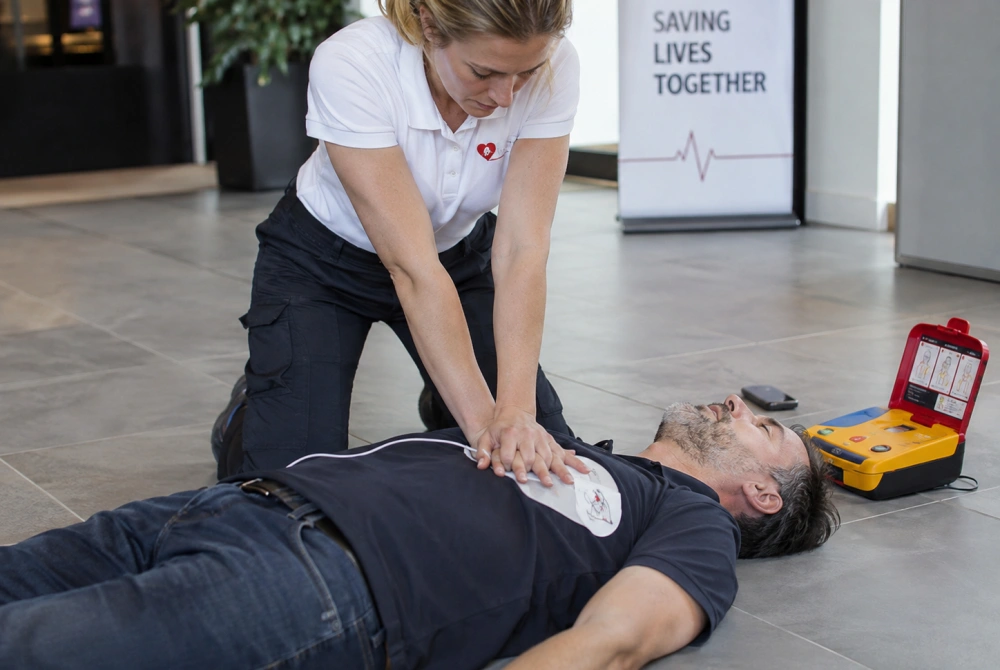
In the event that the choking victim becomes unresponsive, the process changes completely to: Unresponsive → Dial for emergency help → Acquire AED → Do CPR
In cases where there are other people around, one person calls for emergency help and gets the Automated External Defibrillator (AED), while another starts CPR.
How Does CPR Help?
CPR is done to support circulation in cases when a patient is unconscious and does not breathe properly. Chest compressions may be helpful in clearing any airway obstruction.
For an adult, the normal number of compressions per minute is:100-120 per minute.
The correct depth for an adult during chest compressions is:5-6 cm.
CPR should be done as per the existing guidelines.
If an object is seen while doing CPR to clear the airway, then only the object should be removed.
Recall:
Visible Object = Remove Object Carefully
No Visible Object = No Finger Sweep
Why Does Choking Become Dangerous So Quickly?
A case of severe choking can affect the supply of oxygen in the following manner: Airflow Reduced → Oxygen Content in Blood Reduced → Hypoxia in Brain and Heart
What was initially an everyday experience of eating could turn out to be a medical emergency where CPR might be needed.
After clearing the airway, the individual might need to visit a doctor if he lost consciousness, underwent CPR, has difficulty breathing, or experienced a vigorous chest/abdominal thrust.
Conclusion
The first step that needs to be taken in case of choking is to establish whether the person has effective airflow. If he or she can cough powerfully, it is necessary to continue to assist him or her in coughing. Inability to speak, cough, or breathe properly may mean the presence of a serious airway blockage.
If the victim loses consciousness, he or she should be resuscitated.
Effective Cough → Continue to Assist in Coughing
Inability to Speak/Cough/Breathe → Immediate Assistance
Loss of Consciousness → CPR & EMS Call
It is very important to know the difference between an effective cough and severe airway blockage.
0