

目录
In high-intensity sports such as cycling, running, skiing, and mountain climbing, visual performance plays a crucial role in both safety and efficiency. Athletes must deal with rapidly changing light conditions, fast movement, and environmental challenges such as glare, dust, and wind. Choosing the right lens type for sports sunglasses can significantly improve reaction time, reduce eye strain, and enhance overall performance. Different lens technologies serve different purposes, and selecting the right one depends on the sport and environment. Many advanced designs developed by a sports sunglasses manufacturer focus on optimizing lens performance for extreme outdoor conditions.
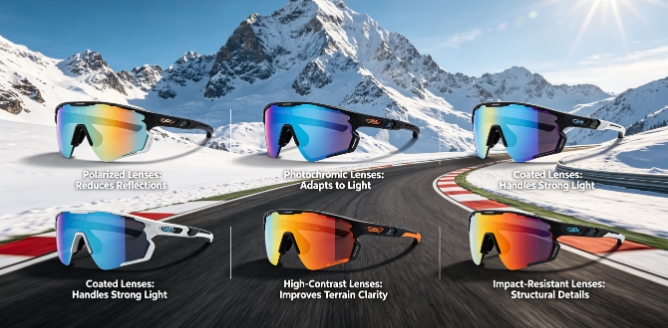
Polarized Lenses for Glare Reduction
Polarized lenses are one of the most popular choices for high-intensity outdoor sports because they effectively reduce glare from reflective surfaces.
- These lenses use a special filter that blocks horizontally reflected light, which is the primary cause of glare on water, roads, and snow.
- By reducing intense reflections, athletes can see more clearly and maintain better focus during fast-paced movement.
- Cyclists and runners benefit greatly from polarized lenses when training in bright sunlight or near reflective urban surfaces.
This lens type improves visual comfort and safety in environments with strong light reflection.
Photochromic Lenses for Changing Light Conditions
Photochromic lenses automatically adjust their tint based on sunlight intensity, making them ideal for sports with varying light conditions.
- These lenses darken in bright sunlight and become clearer in low-light environments, providing continuous visual comfort.
- They eliminate the need to switch between different sunglasses during activities that move between indoor and outdoor areas.
- Many high-performance models designed by a sports sunglasses manufacturer integrate photochromic technology to support athletes in unpredictable environments.
This adaptability makes them especially useful for long-distance runners and cyclists.
Mirror-Coated Lenses for Extreme Brightness
Mirror-coated lenses are designed for extremely bright conditions where sunlight intensity is very high.
- The reflective coating reduces the amount of visible light entering the eyes, lowering glare and eye strain.
- These lenses are particularly effective in high-altitude sports, desert environments, and snow-covered landscapes.
- They also help maintain cooler visual perception by reflecting excess light away from the lens surface.
Mirror coatings are often combined with other lens technologies for enhanced performance in extreme sports.
High-Contrast Lenses for Enhanced Visibility
High-contrast lenses are specifically designed to improve depth perception and visual clarity in dynamic environments.
- They enhance color differentiation, making it easier to detect terrain changes, obstacles, and surface variations.
- This is especially important in trail running, mountain biking, and off-road sports where quick decision-making is required.
- Advanced optical designs from a professional sports sunglasses manufacturer often include high-contrast filtering to support precision-focused athletes.
These lenses help improve reaction time and overall situational awareness.
Impact-Resistant and Safety-Focused Lenses
In high-intensity sports, physical impact is always a potential risk, making lens durability a key consideration.
- Impact-resistant lenses are designed to withstand sudden shocks, flying debris, and accidental contact without breaking.
- Materials such as polycarbonate are commonly used due to their combination of strength and lightweight properties.
- Safety-focused designs ensure that lenses remain intact even under extreme pressure, protecting the athlete’s eyes.
These features are essential for contact-heavy and high-speed sports environments.
Conclusion
The best lens types for sports sunglasses in high-intensity sports depend on specific environmental and performance needs. Polarized lenses reduce glare, photochromic lenses adapt to changing light, mirror coatings handle extreme brightness, high-contrast lenses enhance visibility, and impact-resistant lenses provide essential safety. Each lens type plays a unique role in improving athletic performance and protecting the eyes. With advanced engineering from a sports sunglasses manufacturer, modern sports sunglasses combine these technologies to meet the demanding needs of professional and recreational athletes alike.
0