
目录
Among other techniques, freezing is the most effective technique for increasing the shelf life of meat, fish, prepared food, and leftover food. But there is a false belief that food placed in a freezer will remain fresh forever.
It is not true.
The process of freezing prevents microbial activity and numerous physical and biochemical processes but does not completely prevent changes in food. In addition, freezing leads to loss of moisture, oxidation of fats, crystal formation of water, and deterioration of flavors.
The main difference is: Food Safety ≠ Food Quality
If proper handling and continuous storage at temperatures of 0°F or below are guaranteed, food can be preserved for a long period of time. However, quality characteristics of the food will decrease over time.
1. Does Freezing Food Stop It From Going Bad?
Freezing Slows Microbial Growth
Food spoilage occurs due to the influence of bacteria, yeasts, fungi, enzymes, oxygen, and moisture. Freezing reduces the amount of liquid water available for microorganisms’ activities, as much of the water contained in the food turns to ice. The low temperature significantly slows down the growth of many microorganisms.
This means that freezing follows a very simple scheme: Low Temperature → Lower Growth of Microorganisms → Less Food Spoilage
But freezing is not a sterilization procedure.
Some microorganisms are able to survive freezing.
Once the food is thawed, and the temperature rises to the one that allows microorganisms to develop, then these microorganisms can start their activity again.
That is why freezing does not eliminate the danger of unsafe handling of the food.
To store food in home conditions, it is recommended to set a freezer to:0°F (-18°C) or less
And a refrigerator to:40°F (4°C) or less
It is important to keep temperatures constant.
Why Does Frozen Food Still Change?
Even when microbial growth is controlled, physical and chemical changes continue slowly.
Common examples include:
• Moisture loss
• Ice crystal formation
• Fat oxidation
• Color changes
• Texture damage
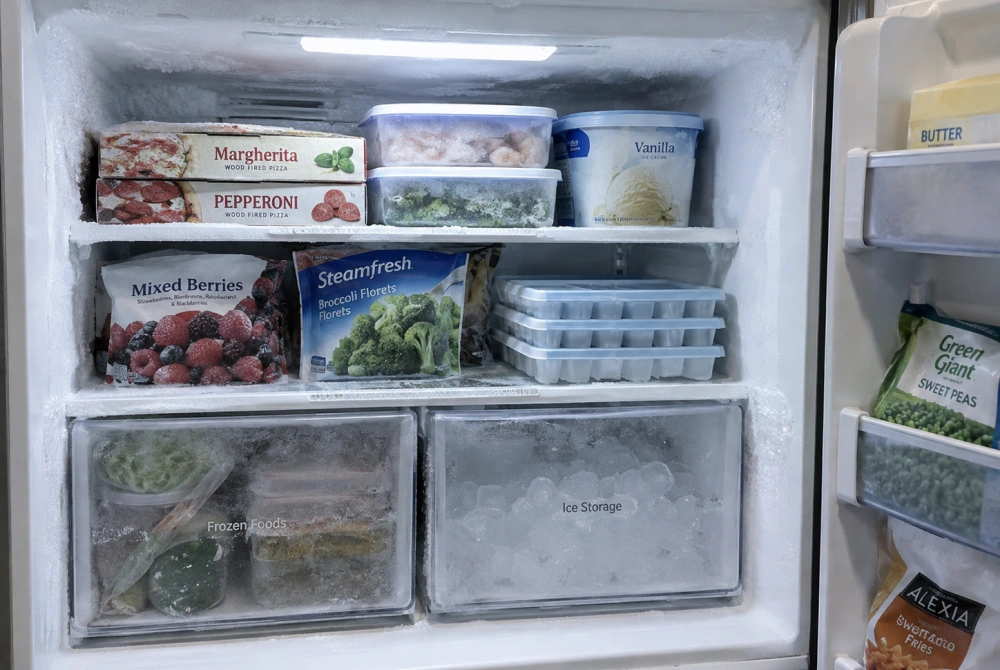
Another common one is freezer burn. This happens when frozen foods lose their surface moisture, which may happen due to bad packaging or being exposed for too long to dry air inside the freezer.
Freezer burn impacts the quality of food, and not its safety. Freezer burn does not imply that the food is unsafe because it simply renders the food very unpalatable.
In simpler terms: Frozen ≠ The Same
2. How Long Does Freezing Food Actually Preserve It?
Different Foods Have Different Storage Times
There is no universal rule when it comes to storage limits for frozen foods.
Type of food, fat level, packaging, state of food prior to freezing, temperature in the freezer, and temperature stability will all have an impact on the results.
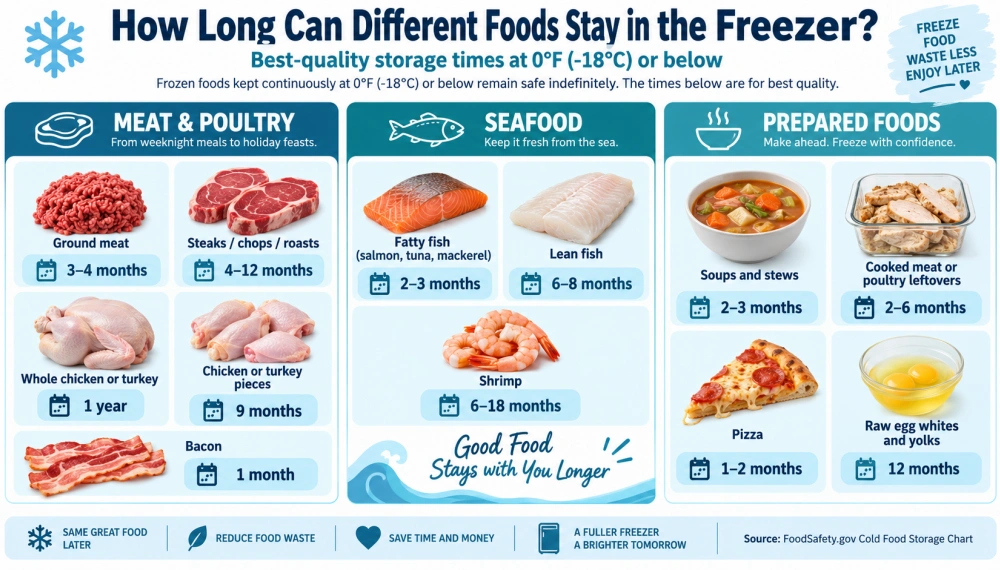
The following periods are useful general references for maintaining good quality:
| Food | Freezer Time for Best Quality |
| Ground meat | 3–4 months |
| Beef steaks or chops | 4–12 months |
| Whole chicken or turkey | Up to 12 months |
| Chicken pieces | Up to 9 months |
| Cooked meat | 2–3 months |
| Soups and stews | 2–3 months |
| Bacon | About 1 month |
These periods should not be treated as exact safety deadlines.
As an example, a guideline suggesting that one should consume ground meat within 3–4 months refers to the quality of the product only. This does not imply that the product suddenly turns into an unhealthy food from day one of month five.
Why Do Storage Times Vary?
The makeup of foods is important.
Different foods have varying amounts of water, fat, proteins, etc. The fat will undergo oxidation, changing the taste and smell, and foods high in water content can be affected by the formation of ice crystals and suffer more structural damage.
Changes in temperature will only worsen the issue.
Here is an example of the process: Freezing -> Thawing -> Refreezing
With temperature changes, small ice crystals may melt and turn into bigger crystals, which can damage cell structure, causing further dehydration.
Freezing Does Not Reset Food Safety
How the food was stored prior to freezing is just as important as how long it remains frozen.
Once perishable foods are allowed to stay at room temperature for an excessive amount of time, freezing will not undo any potential growth of microorganisms.
One of the most common food safety standards states that perishable foods usually should not be kept at room temperature for more than 2 hours.
If the ambient temperature is above 90°F (32°C), this time frame is decreased to 1 hour.
Instead of merely wondering about: How long has this food been frozen?
Ask yourself: How was it stored before freezing?
3. How Can You Make Frozen Food Last Longer?
Reduce Exposure to Air
Air is one of the major enemies of frozen food quality.
The presence of air inside packages causes loss of moisture and oxidation, resulting in the risk of freezer burn and flavor degradation.
Useful storage options include:
• Freezer-safe bags
• Airtight containers
• Freezer-safe wrapping
• Vacuum-sealed packaging
It is quite simple: Less air = Less water loss = Less oxidation = High quality
When the packaging of meat, fish, and processed products should last several months, then good packaging becomes vital.
Freeze Food in Practical Portions
Instead of freezing a single large packet that will have to be manipulated or thawed multiple times, freeze the food in smaller packets.
One simple process could be: Packet → Pack → Label → Date → Freeze
Each pack should carry at least the name of the food along with its freezing date. This will make it easy for a FIFO (First In, First Out) management system as well.
Keep the Freezer Temperature Stable
The freezer must stay below 0°F (-18°C).
Electricity failures can cause confusion. If the freezer is full, it will be able to stay at a safe temperature for up to 48 hours with the door closed, whereas a half-full freezer will stay at a safe temperature for up to 24 hours.
Once electricity resumes, do not go by the odor alone. Food that has ice crystals in it or stays at 40°F (4°C) or lower is safe for refreezing and cooking.
Thaw Food Safely
Good freezing practices can be undermined by poor thawing.
| Thawing Method | General Guidance |
| Refrigerator | Good for slow, controlled thawing |
| Cold water | Suitable when properly managed |
| Microwave | Usually cook promptly afterward |
| Room temperature | Avoid prolonged thawing of perishables |
Repeated freezing and thawing can also reduce moisture retention and texture, even when food remains safe.
Conclusion
Food can be stored for months by freezing it, but it will not preserve the freshness of the food indefinitely.
Continuous freezing of food at 0°F (-18°C) will drastically reduce microbial activity, but water loss, oxidation, formation of ice crystals, and other factors may develop over time. That is why food safety and food quality are equally important in assessing frozen food.
Food packaging, consistent temperature control, appropriate portioning, labeling of expiration dates, and safe thawing procedures are more helpful than just trying to freeze food as long as possible.
Food freezing can slow down many processes that cause food spoilage, but it will not preserve the freshness of the food forever.
0