
目录
In modern broadband infrastructure, Fiber to the Home (FTTH) has become one of the most important technologies for delivering high-speed internet directly to end users. Within this system, the fiber optic drop cable plays a critical role in connecting the main distribution network to individual homes or buildings. It acts as the final link in the communication chain, ensuring that optical signals are delivered efficiently and reliably. Understanding the specific applications of fiber drop cables in FTTH network deployments helps clarify the crucial role they play in constructing stable, high-performance internet systems.
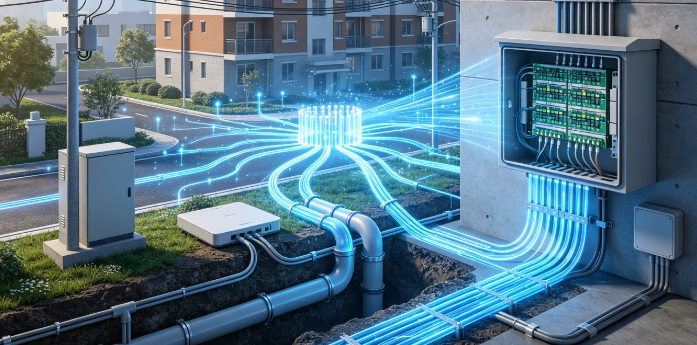
Final Connection Between Distribution Network and End Users
The primary function of fiber optic drop cable in FTTH deployment is to serve as the last-mile connection.
- Bridging network infrastructure: It connects the outdoor fiber distribution point, such as a splitter or terminal box, directly to the subscriber’s premises.
- Ensuring signal continuity: Without this cable, the optical signal from the main network cannot reach individual homes or offices effectively.
- Supporting residential broadband access: It enables households to receive high-speed internet services, including streaming, online gaming, and cloud applications.
- Flexible routing options: The cable can be installed aerially, underground, or along building walls, depending on infrastructure requirements.
This final connection is essential for completing the FTTH architecture.
Signal Transmission Stability in Last-Mile Delivery
Another important use of fiber optic drop cable in FTTH networks is maintaining stable signal quality during final transmission.
- Low signal loss performance: The cable is designed to minimize attenuation, ensuring strong optical signal delivery over short distances.
- Resistance to environmental interference: Unlike copper cables, fiber optic drop cable is immune to electromagnetic interference, making it highly stable in urban environments.
- Consistent data speed delivery: It helps maintain high bandwidth performance from the network node to the user endpoint.
- Resilience to External Noise: Signals remain unaffected, even in areas with high electrical activity.
These features ensure reliable internet service quality for end users.
Physical Connectivity in the FTTH Installation Process
Fiber optic drop cable is also used as a physical installation component that completes the FTTH setup process.
- Connection to optical network terminals (ONTs): The cable links outdoor fiber networks to indoor devices that convert optical signals into usable internet data.
- Indoor and outdoor transition support: It is designed to function across different environments, ensuring seamless signal transition from street-level infrastructure to indoor systems.
- Easy deployment in residential buildings: Installation can be completed through walls, conduits, or exterior mounting systems.
- Adaptability to different building types: Suitable for apartments, single-family homes, and commercial units.
This versatility makes it an indispensable component in FTTH deployment projects.
Protection and Reliability in Network Infrastructure
In FTTH deployment, fiber optic drop cable also plays a protective role in maintaining network reliability.
- Mechanical protection of fiber strands: The outer jacket shields delicate optical fibers from physical damage during installation and operation.
- Resistance to weather conditions: Outdoor-rated cables are designed to withstand rain, sunlight, and temperature changes.
- Strain relief functionality: It helps reduce tension at connection points, preventing signal disruption caused by physical stress.
- Long-term operational stability: Once installed, the cable provides stable performance with minimal maintenance requirements.
These protective features help ensure lasting network performance.
Supporting High-Speed Broadband Services
Fiber optic drop cable is essential for enabling advanced broadband applications in FTTH networks.
- High-Speed Internet Access: Supports gigabit-level data transmission to meet the demands of modern digital services.
- Streaming and multimedia applications: Ensures smooth video streaming, video conferencing, and online content delivery.
- Smart home integration: Enables seamless operation of IoT devices, smart appliances, and automated home control systems.
- Business and remote work solutions: Provides stable connectivity for cloud computing and remote collaboration tools.
These capabilities make it a core element in modern digital infrastructure.
Conclusion
In summary, fiber optic drop cable is used in FTTH network deployment as the final connection between the distribution network and end users, ensuring stable signal transmission, reliable physical connectivity, and protection of optical signals. It plays a crucial role in enabling high-speed broadband services and supporting modern digital applications in homes and businesses. As global FTTH networks continue to expand, fiber drop cables remain an indispensable and critical component in building efficient, scalable, and future-proof communication systems.
0