
目录
Educational toys have become an essential part of modern learning environments, bridging the gap between play and structured education. As parents and teachers increasingly recognize the benefits of hands-on learning, the demand for such products continues to grow rapidly. However, not every educational toy is suitable for both home and classroom use. Differences in learning goals, safety requirements, group interaction needs, and durability standards all influence where a toy can be effectively used. With the expansion of global sourcing channels, including educational toy wholesale networks, schools and families now have access to a wider variety of learning tools, making it even more important to choose the right type of toy for each environment.
1. Differences Between Home and Classroom Learning Environments
The learning environment plays a crucial role in determining whether an educational toy is suitable for home use, classroom use, or both. Each setting has different expectations and usage patterns.
Key distinctions include:
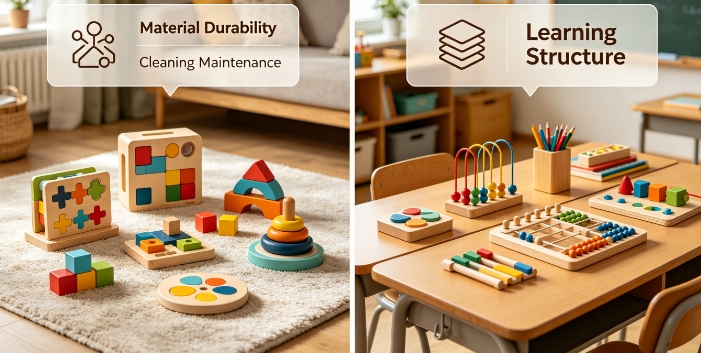
- Learning structure: Home learning is usually flexible and unstructured, while classrooms follow a fixed curriculum and teaching objectives.
- Supervision level: At home, children may play independently or with parents, whereas in classrooms involve teacher-led supervision and group management.
- Usage intensity: Classroom toys are often used repeatedly by many children, requiring higher durability and standardized functionality.
- Learning focus: Home use tends to focus on creativity and entertainment, while classroom use emphasizes measurable educational outcomes.
These differences mean that a toy designed for one environment may not always perform effectively in the other.
2. Key Features That Determine Suitability
Not all educational toys are designed with dual-use scenarios in mind. Certain features determine whether a toy can transition smoothly between home and classroom settings.
Important considerations include:
- Durability and safety: Classroom toys must withstand frequent use and meet strict safety standards due to group interaction.
- Educational adaptability: Toys that support multiple learning levels are more suitable for both environments.
- Ease of instruction: Simple-to-understand toys work better in classrooms where teachers manage multiple students at once.
- Cleaning and maintenance: Toys used in schools must be easy to clean and maintain hygiene, especially for shared use.
These factors help educators and parents evaluate whether a toy is practical for different learning environments.
3. How Educational Toys Function Differently in Each Setting
Even when the same toy is used in both environments, its role and learning impact may differ significantly depending on context.
For example:
At home:
- Children often explore freely without time constraints.
- Parents may use toys to strengthen bonding and communication.
- Learning is usually informal and guided by curiosity.
In classrooms:
- Teachers use toys as part of structured lesson plans.
- Group activities encourage teamwork and communication skills.
- Learning outcomes are assessed and aligned with educational goals.
Because of these differences, a toy that works well at home may require adaptation before it can be effectively used in a classroom environment. The increasing availability of products through educational toy wholesale suppliers has made it easier for schools to select classroom-appropriate versions of popular toys.
4. Challenges in Using the Same Toy Across Both Environments
While dual-use educational toys exist, they are not always perfectly suited for both settings. Several challenges may arise when attempting to use the same toy at home and in school.
Common challenges include:
- Over-simplification or over-complexity: A toy designed for classroom instruction may be too structured for home play, while home toys may lack depth for classroom learning.
- Group vs. individual usage issues: Some toys are designed for one-on-one interaction and may not support group activities effectively.
- Durability mismatch: Lightweight toys suitable for home use may wear out quickly in school environments.
- Instructional limitations: Without teacher guidance, some classroom-oriented toys may be difficult for children to use independently at home.
These challenges highlight the importance of selecting toys based on their intended learning context rather than assuming universal suitability.
5. Growing Market Demand and Product Diversification
The global demand for educational toys has led to significant innovation and diversification in product design. Manufacturers are increasingly developing toys that can serve multiple purposes across different environments.
Market trends include:
- Multi-functional designs: Toys that support both independent play and structured classroom learning.
- Age-flexible learning systems: Products designed to adapt to different developmental stages.
- Digital integration: Smart toys that can be used individually at home and collectively in classrooms through connected systems.
- Broader distribution networks: With the growth of educational toy wholesale channels, schools and retailers can access a wider variety of specialized and hybrid learning tools.
This expansion allows educators and parents to choose more effectively based on their specific needs, rather than relying on one-size-fits-all solutions.
Conclusion
Not every educational toy is suitable for both home and classroom use, as each environment has distinct learning goals, supervision styles, and usage conditions. While some toys are versatile enough to function in both settings, many are designed with specific contexts in mind. Understanding these differences helps parents and educators make better decisions that maximize learning outcomes. As the market continues to evolve and distribution networks such as educational toy wholesale expand, the variety and specialization of educational toys will continue to grow, offering more targeted solutions for both home learning and classroom education.
0