
目录
In modern manufacturing, companies are constantly under pressure to produce higher-quality products at lower costs while maintaining fast production speeds. Automation has become a key strategy for achieving this balance, and advanced robotic systems are playing a central role in transforming industrial workflows. Among these technologies, the 5 axis robot arm is widely recognized for its ability to handle complex tasks with high precision and flexibility. Its multi-directional movement and intelligent control systems make it an important tool for improving production efficiency and reducing overall operational costs in various industries.
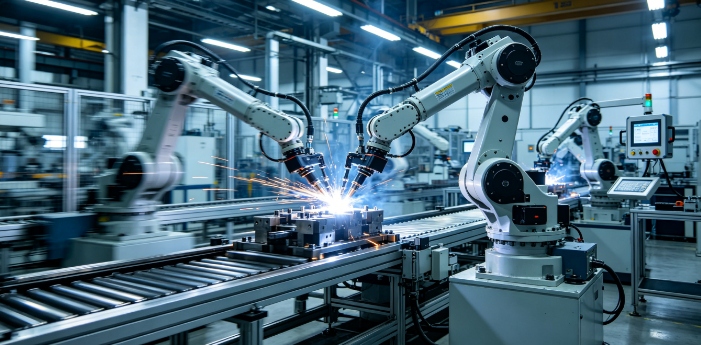
Faster Production Cycles and Continuous Operation
One of the most direct ways a 5 axis robot arm increases production efficiency is by significantly reducing cycle times and enabling continuous operation without fatigue or interruption.
- Unlike human workers, the robot can operate 24/7 without breaks, maintaining consistent output levels across long production shifts.
- Its ability to move across multiple axes allows it to complete complex operations in a single motion, reducing the need for repeated repositioning.
- In assembly or machining tasks, fewer interruptions between steps lead to smoother production flow and shorter overall manufacturing cycles.
- Automated path optimization ensures that movements are efficient, minimizing unnecessary motion and saving valuable production time.
These improvements allow manufacturers to increase output without expanding labor resources or production lines.
Reduced Labor Costs and Workforce Dependence
Another major advantage of using a 5 axis robot arm is the reduction in labor-related expenses and dependency on manual operations.
- Once deployed, the robot can handle repetitive and physically demanding tasks that would normally require multiple workers.
- Companies can reallocate human workers to higher-value roles such as supervision, quality control, and system optimization.
- Reduced reliance on manual labor helps minimize costs related to training, overtime, and workplace injuries.
- In industries with labor shortages, automation ensures stable production without disruption caused by staffing issues.
By lowering workforce dependency, manufacturers can achieve more stable and predictable operational costs over time.
Improved Accuracy and Lower Material Waste
Efficiency is not only about speed but also about minimizing waste. A 5 axis robot arm helps reduce material loss by improving precision and consistency in manufacturing processes.
- High-precision movement ensures that cutting, welding, or assembly tasks are performed accurately, reducing defective outputs.
- Consistent performance eliminates variations that often lead to rework or product rejection.
- Multi-axis control allows better handling of complex geometries, reducing errors during machining or shaping processes.
- Integrated sensors and feedback systems help detect and correct deviations in real time, preventing costly production mistakes.
As a result, manufacturers save significant material costs while maintaining higher product quality standards.
Optimized Workflow and Reduced Downtime
Production efficiency is also heavily influenced by workflow stability and machine uptime. The 5 axis robot arm contributes to smoother operations by minimizing interruptions and improving process coordination.
- Automated systems reduce the need for manual adjustments between production stages.
- Smart scheduling and programming allow multiple tasks to be completed sequentially without stopping the production line.
- Predictive maintenance systems can identify potential issues early, preventing unexpected breakdowns.
- Integration with other automation equipment helps create a fully synchronized production environment.
These factors significantly reduce downtime and improve overall equipment utilization rates.
Long-Term Cost Efficiency and Scalability
While the initial investment in a 5 axis robot arm may be relatively high, its long-term economic benefits make it a cost-effective solution for large-scale manufacturing.
- Lower defect rates reduce the long-term cost of rework, returns, and quality control failures.
- Energy-efficient operation in modern robotic systems helps reduce utility expenses over time.
- Scalable automation systems allow manufacturers to expand production capacity without proportional increases in labor or infrastructure costs.
- Durable mechanical design ensures long service life with minimal maintenance requirements compared to traditional machinery.
Over time, these advantages contribute to a significantly lower total cost of ownership.
Conclusion
The 5 axis robot arm plays a crucial role in increasing production efficiency and reducing manufacturing costs by improving cycle speed, minimizing labor dependency, enhancing accuracy, optimizing workflow, and delivering long-term economic value. Its ability to perform complex multi-axis operations with high precision makes it a powerful solution for modern industrial automation. As manufacturing continues to evolve toward smarter and more efficient systems, the adoption of advanced robotic technologies like the 5 axis robot arm will remain essential for companies aiming to stay competitive in a global market.
0