
目录
Precision is one of the most important factors affecting product quality, cost control, and brand consistency. A hot sauce filling machine is widely used in the production of chili sauces, ketchup, spicy condiments, and other viscous liquids that require precise portioning. Many manufacturers often ask how accurate a hot sauce filling machine can be when measuring liquids, especially in high-speed production environments. The answer depends on several factors, including filling technology, control systems, machine calibration, and product viscosity. With modern automation and servo-driven systems, today’s filling machines can achieve extremely high accuracy levels, ensuring consistent volume control across thousands of bottles in continuous production lines.
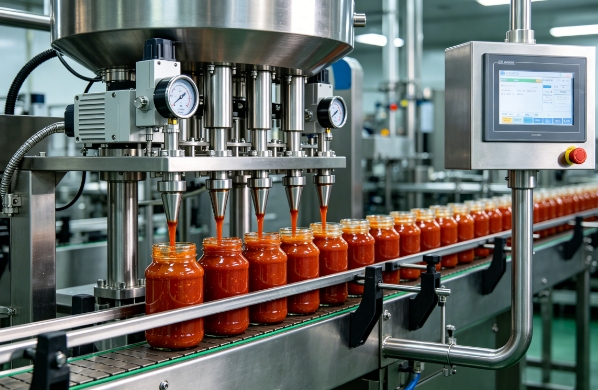
Advanced Filling Technology Ensures High Precision
The accuracy of a hot sauce filling machine largely depends on the type of filling system it uses, as different technologies offer different levels of precision.
- Piston filling systems:
These systems measure liquid by controlling the piston stroke, ensuring highly accurate volume output even for thick or sticky sauces. - Servo motor control technology:
Advanced machines use servo-driven systems that allow precise adjustment of filling volume, improving consistency across production batches. - Time-pressure filling method:
This method controls liquid flow using time and pressure settings, making it suitable for medium-viscosity sauces. - Flow meter-based systems:
High-end machines use digital flow meters to measure exact liquid volume in real time, reducing human error.
These technologies ensure that modern filling systems maintain high accuracy even under demanding production conditions.
Key Factors That Affect Filling Accuracy
Several important variables influence the performance of a hot sauce filling machine, especially when dealing with different types of liquids.
- Liquid viscosity consistency
Thicker sauces may flow more slowly, requiring adjusted pressure settings to maintain accurate filling volumes. - Temperature variations
Temperature changes can affect sauce thickness, which may slightly influence flow speed and measurement precision. - Machine calibration level
Regular calibration ensures that the filling system remains accurate and consistent over long production periods. - Nozzle design and anti-drip control
Well-designed nozzles help prevent dripping or overflow, ensuring each bottle receives the correct amount. - Production speed settings
Extremely high-speed operation may slightly impact accuracy if not properly optimized with control systems.
Understanding these factors helps manufacturers maintain optimal filling performance.
Automation and Smart Control Systems Improve Consistency
Modern hot sauce filling machine systems rely heavily on automation to ensure stable and repeatable accuracy in industrial production.
- PLC intelligent control systems:
Programmable logic controllers allow precise adjustment of filling parameters, ensuring consistent output. - Touchscreen operation interfaces:
Operators can easily set filling volumes, speeds, and batch parameters with high accuracy. - Real-time monitoring sensors:
Sensors detect liquid levels, pressure changes, and flow irregularities to maintain precision. - Automatic correction functions:
The system can self-adjust minor deviations during continuous production to ensure consistent filling results.
These smart features significantly reduce human error and improve long-term production stability.
Influence of Sauce Characteristics on Measurement Precision
The physical properties of the product also play a major role in determining how accurately a hot sauce filling machine performs.
- High-viscosity sauces (e.g., chili paste):
Require slower, more controlled filling to ensure precise measurement and avoid air pockets. - Low-viscosity sauces (e.g., liquid chili oil):
Flow more easily, allowing faster and more consistent filling accuracy. - Particle-containing sauces:
Products with seeds or chunks may require specialized nozzles to maintain consistent volume. - Oil-based sauces:
Require stable temperature control to prevent density changes during filling.
Proper machine configuration based on product type ensures optimal accuracy in real production environments.
Maintenance and Calibration for Long-Term Accuracy
Even the most advanced hot sauce filling machine requires regular maintenance to maintain consistent measurement accuracy over time.
Routine calibration checks
Regular calibration ensures that filling volumes remain within acceptable tolerance ranges.
Cleaning of filling nozzles
Residual sauce buildup can affect flow consistency, making cleaning essential for accuracy.
Inspection of sealing components
Worn seals may lead to leakage or inconsistent filling volumes if not replaced promptly.
Lubrication and mechanical upkeep
Proper maintenance of moving parts ensures smooth operation and reduces measurement deviation.
These maintenance practices help ensure long-term reliability and stable production accuracy.
Conclusion
In conclusion, a modern hot sauce filling machine can achieve very high levels of accuracy in measuring liquids, especially when equipped with advanced technologies such as servo control systems, flow meters, and intelligent automation. While factors like viscosity, temperature, and production speed can influence performance, proper machine configuration and regular maintenance ensure consistent and precise filling results. As food manufacturing continues to demand higher efficiency and tighter quality control, hot sauce filling systems remain essential equipment for delivering accurate, stable, and scalable production in the condiment industry.
0