
目录
Transflective LCDs are widely used in outdoor environments because they maintain clear visibility under changing lighting conditions. Unlike traditional LCDs that become hard to read in sunlight, they combine reflective and transmissive technologies to use ambient light while still supporting backlighting. This improves readability in both bright and low-light settings while also reducing power consumption. As a result, they are commonly applied in industrial equipment, transportation systems, marine devices, and portable electronics where reliable outdoor performance is essential.
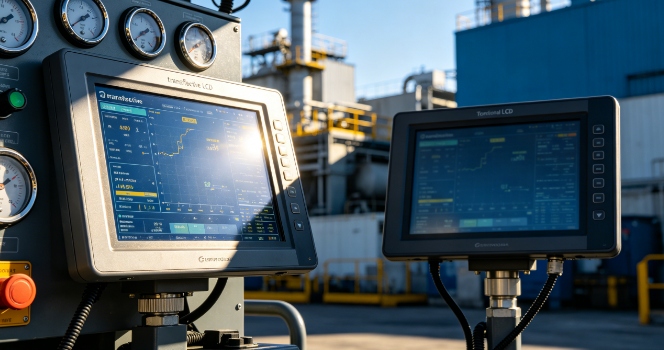
Superior Sunlight Readability
One of the most significant advantages of transflective LCDs is that their displayed content remains clearly visible even under direct sunlight—a major challenge for traditional display technologies.
- Uses ambient light effectively: Instead of fighting against sunlight, the display reflects external light back toward the viewer to improve image clarity.
- Reduced glare problems: The reflective layer helps minimize the washed-out effect that often occurs on traditional screens in bright environments.
- Higher Contrast in Sunlight: Bright outdoor environments actually enhance—rather than diminish—
- Stable Image Quality: Users can clearly read text, graphics, and operational data without needing to adjust the backlight brightness to its maximum level.
This exceptional sunlight readability is precisely one of the primary reasons why transflective LCDs are widely selected for outdoor equipment and field operations.
Better Energy Efficiency in Outdoor Conditions
Another important reason this technology is preferred outdoors is its ability to reduce power consumption while maintaining visibility.
Key energy-saving advantages include:
- Reduced backlight dependence
In bright conditions, the display relies more on reflected ambient light instead of continuously operating at high backlight brightness. - Extended battery life
Portable devices such as GPS units and handheld scanners can operate longer without frequent charging. - Lower heat generation
Reducing backlight brightness means less energy is converted into heat, thereby enhancing system stability. - Efficient daytime operation
Outdoor equipment working under sunlight can maintain readability with significantly lower power usage.
Since outdoor equipment often relies on battery systems or requires continuous operation, these energy-saving features make transflective LCDs highly practical.
Improved Reliability in Harsh Environments
Outdoor applications often involve difficult environmental conditions, and the transflective LCD is designed to perform reliably in such situations.
- Stable visibility under changing weather: Whether in bright sunlight, cloudy conditions, or partial shade, the display remains readable.
- Temperature Resistance: Many outdoor systems face high temperatures during the day and lower temperatures at night; consequently, the screens are required to possess durable and long-lasting performance.
- Compatibility with rugged designs: These displays are commonly integrated into industrial-grade equipment with vibration and dust resistance.
- Reduced eye strain for operators: Clear readability helps workers and drivers view information more comfortably during long hours outdoors.
This reliability makes the technology especially valuable in industries such as transportation, agriculture, marine navigation, and construction.
Wide Range of Outdoor Applications
The benefits of a transflective LCD make it suitable for many different outdoor use cases across multiple industries.
- Transportation systems: Vehicle dashboards, railway control systems, and marine navigation panels rely on strong daylight visibility.
- Industrial machinery displays: Construction and agricultural equipment use these screens for real-time monitoring of operational performance and data.
- Portable outdoor electronics: GPS devices, military tools, and handheld field equipment benefit from low power consumption and clear readability.
- Public Information Systems: Screens required for outdoor kiosks and traffic displays must remain clearly visible even under direct sunlight.
Its flexibility across a wide range of application scenarios fully substantiates why this technology continues to occupy an increasingly prominent position in the field of outdoor display solutions.
Conclusion
The transflective LCD is better for outdoor displays because it combines strong sunlight readability, energy efficiency, and reliable performance in changing environmental conditions. Unlike traditional LCDs that struggle under direct sunlight, this technology uses ambient light to enhance visibility while reducing backlight dependence. Its ability to conserve energy, extend battery life, and maintain clear image quality makes it an ideal choice for industrial equipment, transportation systems, and portable outdoor devices. Although it may not always be necessary for indoor applications, its advantages in outdoor environments make it one of the most practical and effective display solutions available today.
0