

目录
As display technology continues to evolve, immersive visual experiences have become a major focus across both commercial and entertainment industries. Among the most innovative solutions is the glasses free 3d display, which enables users to view three-dimensional content without wearing special eyewear. This technology uses optical systems such as lenticular lenses or parallax barriers to create depth perception directly on the screen. As businesses and content creators seek more engaging ways to captivate audiences, a critical question has surfaced: Is glasses-free 3D display technology truly suitable for the commercial and entertainment sectors? The answer depends on its visual impact, practicality, cost efficiency, and application scenarios.
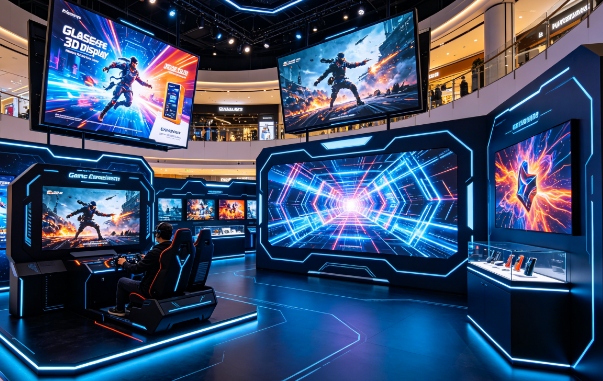
Strong Visual Impact in Commercial Applications
One of the main reasons the glasses free 3d display is widely considered for commercial use is its ability to deliver powerful visual attraction in public environments.
- Attention-grabbing presentation: 3D visuals naturally stand out compared to traditional 2D screens, making them highly effective in shopping malls, airports, and exhibitions.
- Enhanced product showcasing: Businesses can present products with realistic depth, helping customers better understand shape, structure, and design details.
- Enhancing Brand Image: Companies that adopt 3D display technology are often perceived as being more innovative and technologically advanced.
- Dynamic advertising content: Motion-based 3D visuals create stronger engagement than static posters or standard video screens.
These features make the technology especially valuable in marketing-driven environments where first impressions are critical.
Applications in Entertainment and Media Experiences
In the entertainment industry, the glasses free 3d display is increasingly used to create immersive and interactive viewing experiences.
- Gaming environments:3D visuals enhance realism by adding depth to characters, environments, and interactive elements.
- Film and animation previews: Studios use glasses-free 3D screens for content review and promotional showcases without requiring audience accessories.
- Theme parks and attractions: Interactive 3D installations provide visitors with engaging and memorable experiences.
- Digital Art Exhibition: Artists utilize 3D display technology to present creative works featuring enhanced spatial perception and visual storytelling effects.
These applications demonstrate how the technology enriches entertainment value by increasing immersion and engagement.
Advantages for Commercial Efficiency and User Engagement
Beyond visual appeal, glasses free 3d display also offers several operational and user experience benefits in commercial environments.
- No need for additional equipment: Unlike traditional 3D systems, there is no requirement to distribute or manage glasses for viewers.
- Multi-viewer accessibility: Multiple people can view content simultaneously, making it suitable for public spaces and events.
- Simplified maintenance: Without wearable devices, businesses reduce cleaning, replacement, and logistical costs.
- Faster audience interaction: Viewers can immediately engage with content without setup delays, improving flow in retail or exhibition spaces.
These advantages contribute to smoother operations and more efficient customer engagement strategies.
Limitations in Real-World Commercial and Entertainment Use
Despite its promising prospects, naked-eye 3D display technology still faces certain limitations that hinder its widespread adoption.
- Viewing Angle Limitations: Optimal 3D effects may be visible only from specific positions, thereby limiting flexibility in crowded spaces.
- Higher production costs: Advanced optical structures and hardware increase overall investment compared to standard displays.
- Content adaptation requirements: Not all digital content is originally designed for glasses-free 3D rendering, requiring additional development work.
- Resolution trade-offs: Some systems may reduce effective resolution when generating stereoscopic effects.
These challenges mean that while the technology is powerful, it is not yet universally ideal for every commercial or entertainment scenario.
Industry Suitability and Future Development Potential
Despite limitations, the suitability of glasses free 3d display continues to grow as technology improves.
- Retail and advertising sectors: High adoption due to strong visual marketing benefits.
- Education and training exhibitions: Used for interactive demonstrations and product showcases.
- Entertainment venues: Increasingly adopted in gaming lounges, museums, and themed experiences.
- Corporate presentations: Enhance the visualization of products, designs, and data models.
As hardware becomes more affordable and viewing angles improve, broader adoption across industries is expected.
Conclusion
In conclusion, the glasses free 3d display is highly suitable for both commercial and entertainment use, offering strong visual impact, improved user engagement, and simplified viewing experiences without the need for special eyewear. It is already widely used in advertising, retail, gaming, and exhibition environments where immersive presentation is essential. However, limitations such as viewing angle restrictions and production costs still affect full-scale adoption. Overall, its advantages outweigh its challenges in many practical scenarios, making it a powerful and evolving technology that continues to reshape how audiences experience digital content in commercial and entertainment spaces.
0