
目录
In today’s competitive manufacturing and packaging landscape, companies are increasingly adopting advanced decoration methods to improve product appearance, durability, and production efficiency. One of the most widely used solutions is in mold labeling, a process in which labels are placed inside the mold before injection molding so that they become permanently fused with the product surface. This technology delivers high-quality visuals while also improving resistance to wear, moisture, and chemical exposure. Because of these advantages, in mold labeling has been adopted across multiple industries that require both strong branding and long-lasting product performance.
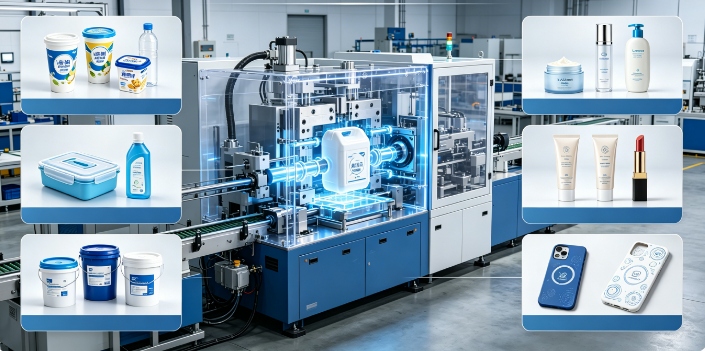
1. Food and Beverage Packaging Industry
The food and beverage sector is one of the largest users of in mold labeling due to its strict requirements for hygiene, durability, and visual appeal.
- Plastic containers for yogurt, ice cream, and margarine often use IML to ensure labels remain intact under cold storage conditions.
- Beverage cups and bottles benefit from moisture-resistant labeling that does not peel or fade during refrigeration or washing.
- The smooth, integrated surface prevents contamination by eliminating gaps where dirt or bacteria could accumulate.
- High-quality printing helps brands stand out on crowded retail shelves, improving consumer recognition.
These features make IML an ideal choice for mass-produced food packaging.
2. Household Goods and Daily Products Industry
Household product manufacturers also rely heavily on in mold labeling to improve both function and design consistency.
- Storage boxes, bins, and kitchen containers use IML to achieve scratch-resistant and long-lasting labeling.
- Cleaning product bottles require labels that resist exposure to detergents, water, and friction during repeated use.
- Decorative household items benefit from customizable patterns and colors that enhance home aesthetics.
- Durable labeling reduces the need for rebranding or replacement, lowering long-term production costs.
This industry values IML for its combination of practicality and visual enhancement.
3. Cosmetics and Personal Care Industry
The cosmetics industry uses in mold labeling to create premium packaging that reflects brand identity and product quality.
- Skincare containers such as cream jars and lotion bottles use high-definition printing for a luxury appearance.
- Chemical resistance ensures labels remain intact when exposed to oils, alcohol, or other cosmetic ingredients.
- Smooth integrated surfaces provide a high-end tactile experience that improves consumer perception.
- Customized shapes and finishes help brands stand out in a highly competitive market.
These advantages make IML particularly important for premium beauty brands.
4. Industrial and Chemical Packaging Industry
In industrial applications, in mold labeling is valued for its durability and ability to withstand harsh environments.
- Lubricant and chemical containers require labels that resist corrosion, oil exposure, and extreme temperatures.
- Industrial storage bins and transport boxes benefit from long-lasting identification markings.
- Safety instructions and warning labels remain clear and readable even after prolonged use.
- Heavy-duty containers often undergo rough handling, where IML ensures labels do not detach or fade.
This makes the technology essential for operational safety and compliance.
5. Electronics and Consumer Products Industry
The electronics sector also adopts in mold labeling for product housings and accessory packaging.
- Remote controls, device casings, and plastic components use IML for durable branding and instructions.
- The process supports precise graphic detailing, ideal for technical markings and icons.
- Scratch-resistant surfaces maintain product appearance throughout long-term use.
- Consistent labeling improves product standardization across global markets.
This ensures both aesthetic appeal and functional clarity in consumer electronics.
Conclusion
In conclusion, mold labeling is widely used across multiple industries, including food and beverage, household goods, cosmetics, industrial packaging, and electronics. Its ability to combine durability, high-quality printing, and efficient production makes it a preferred solution for modern manufacturers. As demand for sustainable, visually appealing, and long-lasting packaging continues to grow, in mold labeling will remain an important technology driving innovation across diverse industrial sectors.
0