
目录
If your door is difficult to close, there must be some alteration in the interaction between the door, hinges, frame, or latch. This difficulty may result from a misalignment, seasonal humidity, loose hinges, loose screws, a loose latch, or an object obstructing the door’s path. While you may not be able to notice the problem, continuously forcing the door shut could put extra pressure on hinges, screws, frame, and locking hardware.
Firstly, you need to find out what causes the door to be hard to close. A door that rubs against the door frame would have a different fix from a door that has a malfunctioning latch and is unable to meet the strike plate. Knowing the cause would help to determine the appropriate repair and not do any unnecessary modifications to the door.
What Causes a Door Hard to Close?
Misaligned Door Hinges
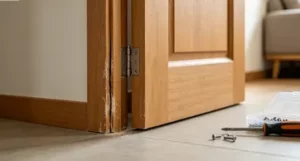
Hinges are responsible for controlling the motion of the door inside the door frame. Loose hinge screws and even just slight misalignment of the hinges would cause the door to move out of its normal alignment and position, causing it to rub against the door frame.
See if there are any gaps or loose hinges or screws in the hinge plates. Specifically, examine the upper hinge since it supports a large share of the door’s weight. If you observe that the door is low at the latch end compared to what it used to be, consider examining its hinge alignment before working on it.
Door Frame Problems
The door frame needs to be stable enough to allow the door to fit properly. If it becomes twisted or shifted, it may cause changes in the gaps between the door and the frame. Building settlement or installation problems, among others, may cause such changes.
One way of determining whether the gaps have been altered is by comparing them. While the actual clearance varies according to the door system used, it provides you with a helpful warning signal. An area with a narrow gap that gradually widens might suggest that either the door or the frame has become misaligned.
Swollen or Warped Door Material
Moisture absorption may cause wooden doors to swell due to temperature and humidity changes, thus affecting the gap. It also causes warping that may prevent the door from closing despite having well-adjusted hinges and hardware.
Indoor humidity commonly varies between approximately 30% and 50% in many occupied spaces. Keeping indoor conditions relatively stable can help reduce unnecessary dimensional changes in wood components. If the problem becomes noticeably worse during humid seasons and improves when conditions become drier, moisture-related expansion may be contributing to the problem.
Obstructions Around the Door
Not every difficult-to-close door has a hardware failure. Small physical obstructions can create enough resistance to affect normal operation. Inspect the entire movement path before adjusting the door. Removing a simple obstruction may solve the problem without requiring changes to the hinges, frame, or door material.
Common examples include:
- Thick or incorrectly positioned weatherstripping
- Carpet or flooring that contacts the bottom edge
- Excess paint around the frame
- Dirt or debris near the hinges or threshold
- Objects positioned directly behind the door
How Do You Fix a Door Hard to Close?
Tighten or Adjust the Hinges
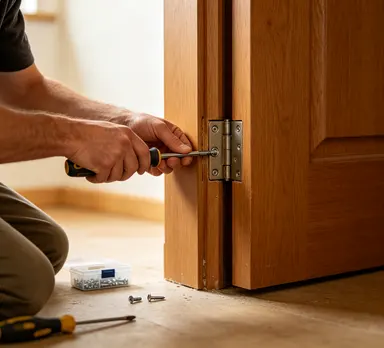
The easiest adjustment is to check all hinge screws and tighten those that appear to be loose. Tightening the screws too much will result in damaging either the screw head or the material around it. In standard residences, the usual number of hinges is three, but in some instances, there could be more.
If a screw no longer grips the frame properly, a longer or otherwise appropriate replacement fastener may be required. However, the replacement should be suitable for the hinge and structural material rather than selected only by length.
Adjust the Strike Plate
If the door moves normally but the latch does not enter the strike plate smoothly, the locking hardware may need adjustment. Close the door slowly and observe where the latch contacts the plate. Any minor misalignment either vertically or horizontally will impede the entrance of the latch into the hole.
Repositioning of the strike plate is done only after identifying the reason for misalignment. This should be done gradually, and after making any adjustments, one should test the door again. By doing so, there will be fewer chances of creating an excessive clearance and weakening the mounting area.
Remove Minor Obstructions
There could be contact at the top, bottom, or sides of the door. If the weatherstripping is compressed too much or the flooring is causing hindrance, then removing the obstruction will do the trick. In cases where debris or paint is the reason for malfunction, cleaning the area will help. Removing a lot of material when the actual reason is still unknown is not advised.
Sand or Trim the Door Carefully
Sanding or cutting is normally something to do after you’ve found the exact contact point, but easier methods haven’t fixed the problem. First, mark the spot, then remove some material rather than cutting the area away vigorously.
When working with a wooden door, it is important to take things slowly since only a couple of millimeters may need to be fixed. Check after each alteration whether the door needs to be replaced or relocated and see how well it operates. If the door or door frame is badly warped, then professional assistance is better than doing plenty of cutting yourself.
How Can You Prevent Your Door From Becoming Hard to Close?
Maintain Hinges and Hardware
Routine hardware checking will help avoid any minor misalignment issues. Make sure that hinge screws, hinge plates, the latch, and the strike plate are checked regularly, especially on those doors that are used often. A simple maintenance routine can include:
| Maintenance Item | Suggested Check |
| Hinge screws | Every 3–6 months |
| Hinges | Check for movement or damage |
| Latch and strike plate | Check alignment |
| Door gaps | Inspect for changes |
| Weatherstripping | Check for excessive compression |
Also, it may be necessary to lubricate moving hardware if it’s possible. Just use the lubrication intended for the specific hinge or latch, and not too much on the surface of the door itself.
Control Indoor Humidity
A constant indoor humidity level is especially critical for wooden doors. The fluctuation of moisture levels can lead to expansion and shrinkage, which may eventually result in a decrease in the space between the door and its frame. If possible, the ideal humidity level indoors should be kept between 30% and 50%. If you live in an area with naturally high humidity, you can use ventilation, air conditioning, or a dehumidifier.
Check Door Alignment Regularly
The early symptoms of misalignment are easier to fix than significant deformations. It is recommended to test your door regularly by opening and closing it and making sure that there are no traces of rubbing, gaps, or difficulty in the operation. If a door that worked smoothly suddenly becomes hard to close, you should investigate why this happens.
Conclusion
A door that does not shut properly could be caused by problems like out-of-alignment hinges, movement of the frame, swelling due to moisture, or just plain obstructions. The best course of action is to locate the area of obstruction before repairing the door.
All other minor problems can be corrected using methods of adjustment, cleaning, or repairs to the hardware. If there is major warping, movement of the structural frame of the door, or damage to parts of the door, it would need to be repaired professionally.
0